Input lag is one of the most frequently cited concerns in retro gaming setups and one of the most frequently misunderstood. It gets blamed for poor game feel, used to justify expensive equipment purchases, and sometimes confused with unrelated issues like signal quality or display artifacts.
This guide explains what input lag actually is, where it comes from in a typical retro setup, and what actually matters for the games you're playing.
What Input Lag Is
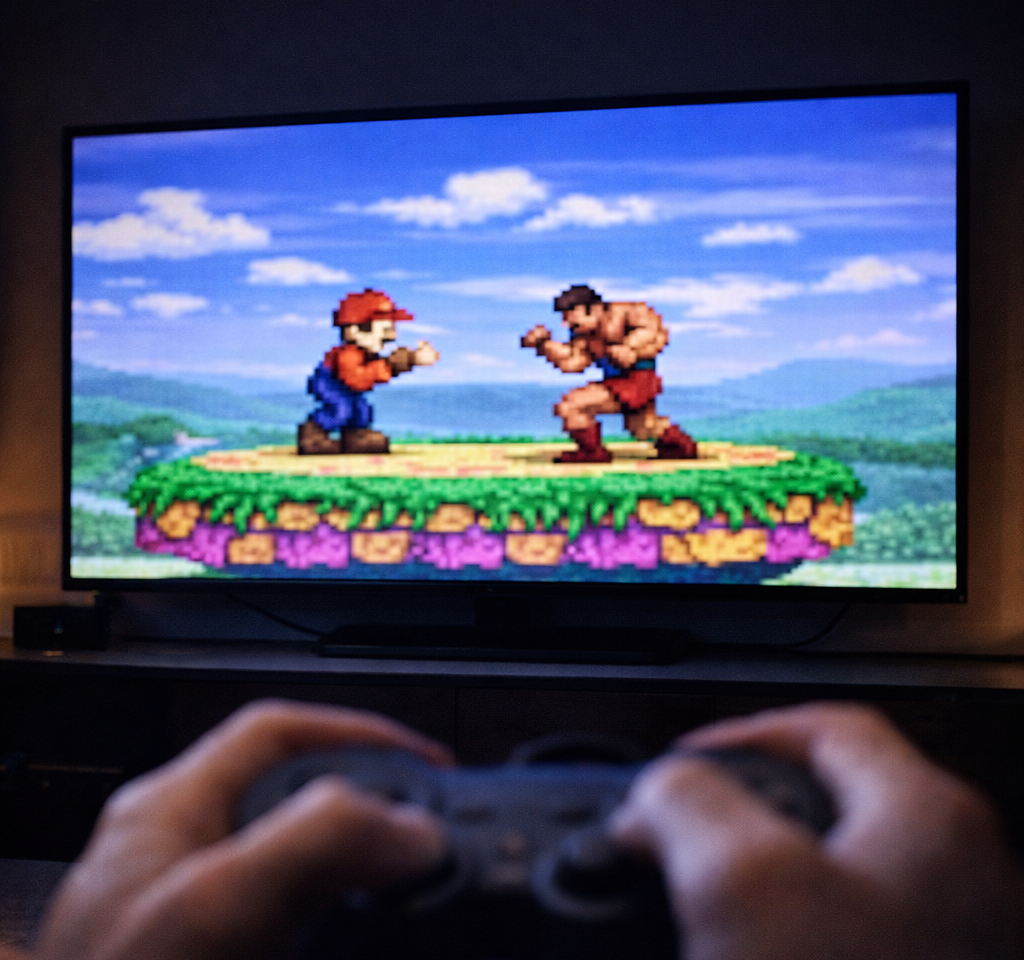
Input lag is the elapsed time between a physical input - a button press on a controller - and the corresponding event appearing on screen. It's measured in milliseconds.
In a retro gaming context, the relevant frame of reference is the original CRT television experience. CRTs were analog displays that drew images line by line as signals arrived, introducing essentially no processing delay. The lag of a CRT at the midpoint of the screen, where half the frame has been drawn, was approximately 8 milliseconds at 60Hz. That's the baseline the original games were designed and tested against.
Modern flat-panel displays do something fundamentally different. They receive the full frame digitally, run it through an image processing pipeline, and then display it. That pipeline - motion smoothing, noise reduction, upscaling, HDR tone mapping - takes time. Without Game Mode, a modern 4K TV can add 50-150 milliseconds of lag on top of the display's inherent response. With Game Mode, which disables most of that pipeline, the same TV typically drops to 10-25 milliseconds.
The Three Sources of Lag in a Converter Setup
In a typical retro gaming setup with a component-to-HDMI converter, there are three places lag can originate.
The converter. A direct converter - one that performs analog-to-digital conversion without upscaling - adds very little lag. The Electron Shepherd converters (ElectronXout for Xbox, ElectronWarp for Wii, ElectronPulse for PS2/PS3) each add less than 1 millisecond as measured with a Time Sleuth lag tester. Budget converters that include upscaling chips frequently add 30-80 milliseconds or more.
TV processing. This is typically the dominant source of lag in a modern setup. With Game Mode enabled on a decent display, you're looking at 10-20 milliseconds. Without Game Mode, that figure multiplies by 3-5x.
The display panel itself. OLED panels have lower inherent display lag than LCD. Within LCD, response time varies by model and panel quality. A smaller contributor than TV processing, but not zero.
Total lag in a well-configured setup - quality direct converter, Game Mode on, good TV - typically lands in the 12-22 millisecond range. That's comparable to or better than the original CRT experience measured at the center of the screen.
What Upscalers Do to Lag
Upscalers add some processing time because they're doing additional work on the signal. How much depends entirely on the quality of the implementation. Budget upscalers add 50-100 milliseconds because their scaler chips process slowly. Purpose-built retro gaming upscalers like the RetroTINK 4K add only a few milliseconds because they're engineered specifically for low-latency retro signal processing.
The practical distinction: a direct converter adds essentially no lag and passes the signal to the TV's internal scaler. An upscaler adds some lag but handles the scaling itself, often producing better results than the TV. For lag-sensitive games, a quality direct converter plus a good TV in Game Mode is typically the right approach.
Does the Lag in Your Setup Actually Matter?
Honestly: it depends on what you're playing.
Puzzle games, RPGs, strategy games, most adventure titles. Total lag under 50-60ms is imperceptible. A mediocre setup is fine.
Platformers and action games with precise jump timing. 30-50ms of added lag starts to feel slightly off to experienced players. Not unplayable, but the game doesn't feel quite right. A quality converter and Game Mode bring this into a comfortable range.
Rhythm games, fighting games, anything requiring frame-accurate inputs. Even 16ms (one frame at 60Hz) changes the feel. These are the setups where the difference between a cheap converter and a quality one is felt during play. Zero-added-lag converter plus Game Mode is worth prioritizing.
Speedrunning or competitive play. Every millisecond matters. Some players still use CRTs specifically because of how they handle motion at equivalent measured lag numbers.
Practical Setup for Minimum Lag
In order of impact: enable Game Mode on your TV first - the single biggest improvement. Use a direct converter without upscaling (the ElectronXout, ElectronWarp, and ElectronPulse each add less than 1ms). Enable 480p output on your console where supported, since progressive scan is processed faster than interlaced by most TVs. Disable motion smoothing, noise reduction, and any other picture processing. If your TV has gaming-designated HDMI inputs, use them.
With all of this in place, most setups land under 25ms total - well within the range where even experienced players can't reliably distinguish the feel from a CRT at normal playing distance.
Less than 1ms added. Verified.
The ElectronXout (Original Xbox), ElectronWarp (Wii), and ElectronPulse (PS2/PS3) each add less than 1ms of lag as measured with a Time Sleuth lag tester. No upscaling chips, no processing delay - direct analog-to-digital conversion and that's it.
Share:
PS2 on a 4K TV: What Works, What Doesn't, and Why
Original Xbox on a Modern TV: The Complete Setup Guide